In May 2023, a symposium was organised by Dr. Shelley James of Age of Light Innovations to discuss the current state of circadian lighting knowledge in the context of the care home sector. The symposium was held at Oxford University, at the home of Prof. Russell Foster’s Sleep and Circadian Neuroscience Institute and brought together a group of professionals, all having a role in circadian lighting development in care homes.
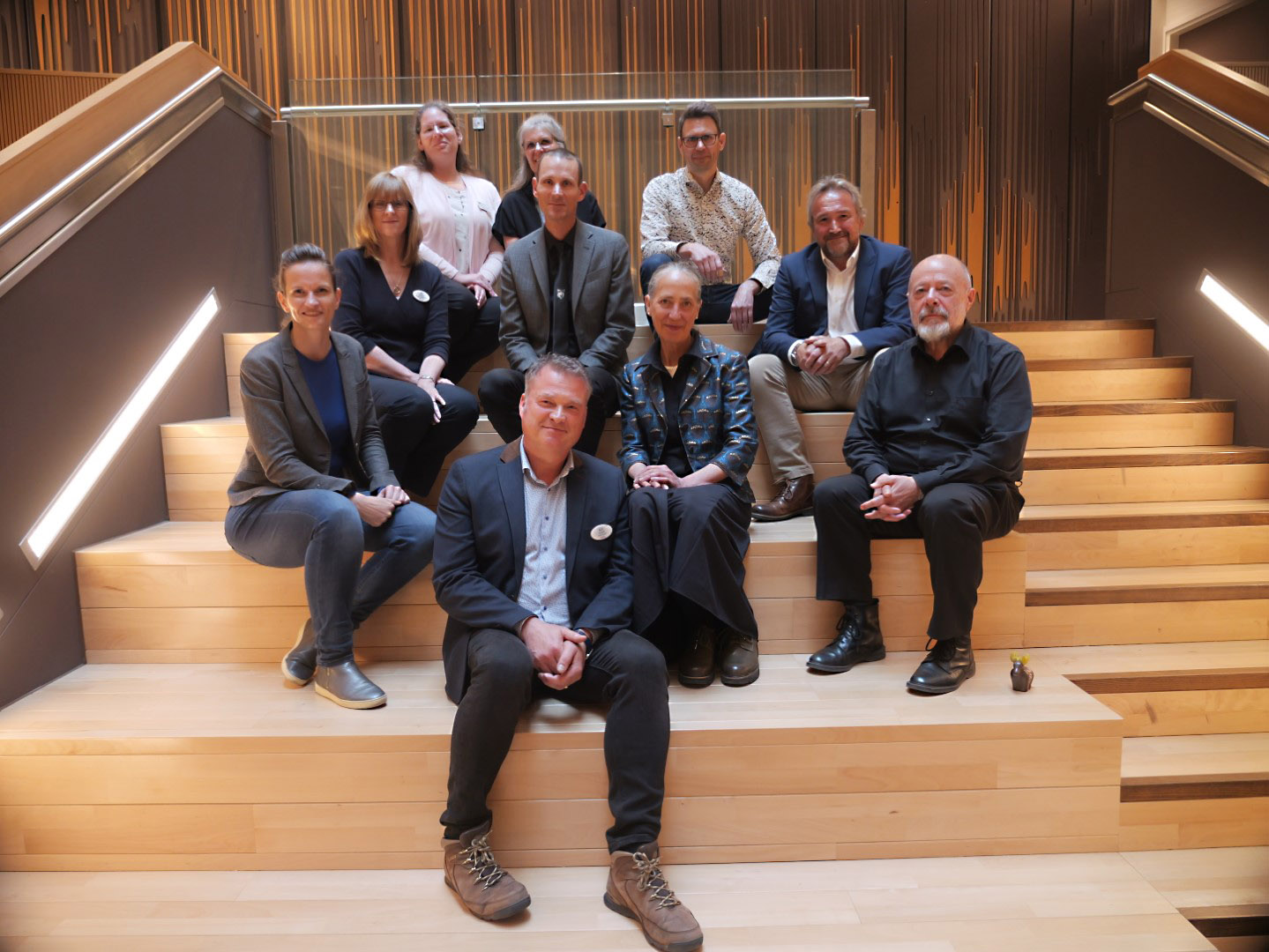
THE SYMPOSIUM PARTICIPANTS WERE:
BACK ROW
Shannon Freeman Associate Professor - Nursing, University of Northern British Columbia
Kirsten Sorensen Gosvig Care Centre manager at Hillerød Municipality
Torben Skov Hansen Head of Innovation at Chromoviso
THIRD ROW
Jo Cheshire, Director of Marketing and Communications, WCS Care
Richard McAloney Director, Centre for Technology Adoption for Aging in the North (CTAN), University of Northern British Columbia
Paul Foulkes MSc MIET Country Manager (UK) Theben Automation; Co-chair KNX UK Association
SECOND ROW
Julia Hartmann IALD CLD Principal, Lightsphere
Dr. Shelley James, Age of Light Innovation
John Bullock: Principal, John Bullock Lighting Design
FRONT ROW
Ed Russell CEO, WCS Care
representing lighting designers and specifiers / makers of circadian lighting systems and senior management of care home providers:
In adddition, we were joined by members of the Oxford circadian Neuroscience team:
- Prof. Russell Foster Circadian Neuroscience, Chair Dept. of Ophthalmology, University of Oxford
- Prof. Stuart Peirson Circadian Neuroscience, University of Oxford
- Lucy Jobbins DPhil Student, Clinical Neuroscience, University of Oxford
To watch video recordings of Common Ground: May 2023
please scroll to the foot of this page.
The symposium opened with an introduction from Prof. Russell Foster, bringing us all up to date on the current research into circadian responses. The news was startling and set the tone for the rest of the day.
Prof. Russell Foster, in short:
For the past decade, we have understood that the circadian response is a consequence of the non-visual receptors in the ipRGCs (intrinsically photosensitive retinal ganglion cells) responding to the amount of melanopic light (broadly around 480nm) in the environment, effectively synchronising the 24-hour body clock. The more melanopic light present, the more that melatonin is suppressed; as the melanopic light content falls away, the more melatonin is released into the body’s system; melatonin became known as the ‘sleep hormone’.
As it now turns out, that’s not quite the case – and never was the case. We now understand that melatonin is produced throughout the body and has an important role as an oxidant, improving the overall effectiveness of the body’s immune systems. The rise in Melatonin levels linked to darkness makes sense as one of the drivers of the body’s healing functions while we sleep.
But as far as the circadian response is concerned, melatonin suppression and production is considered as an indicator of the healthy entrainment of the sleep-wake cycle, which is being determined elsewhere. This is where it gets interesting and possibly a little troubling for those of us who’ve spent that decade explaining how we all thought melatonin worked.
The science is now telling us that our old friends, the rods and the cones, make an active contribution to the entrainment of the circadian cycle – and possibly more than just a role – as the ipRGCs.
Once it’s explained it all makes sense. The ipRGC response is a slow one, akin – if you will – to a calorie counter, where what you eat for lunch has a bearing on your total input for the day. The rods and cones act immediately; if they didn’t we’d spend the whole of our lives in a blur and that’s not evolutionarily sound. We also ‘know’ that what we see and experience feeds our understanding of our environment. A big part of that environment is the availability of natural light. Our farming forebears had no problem knowing when it was time to work and time to sleep, because natural light was there in front of their eyes. And that sense is what we’ve been trying to replicate in our modern built environment..
The new circadian lighting paradigm still calls for a melanopic response, so a light source with a high melanopic ratio is preferred, but the emphasis is switching to illuminance levels,duration of exposure - and an appreciation that there is also a psychological/emotional dimension that has a meaningful effect, tough is not well researched.. This became a serious focus of the day’s conversation.
(see video below: A Framework to Think About Light for Circadian Regulation)
The design / specification response:
What we all have to keep in mind, when talking about effective illuminance levels, is that we’re talking about people’s living spaces. This cannot be a question of overloading the indoor lighting environment by providing more and more illumination; we must stay within comfortable bounds.
That understanding of illumination limits leads to a discussion around light duration. There used to be an idea that an early morning blast of high level, blue-rich, illumination for an hour or so would be sufficient to entrain the 24-hour body clock. But that was only ever about the working environment, designed and tested on working-age people, and was always going to be a costly process and inefficient of light resources and energy usage, to boot.
The care home environment operates a 24-hour cycle. This was one of our first distinctions between ‘commercial (tunable-white) technology’ and circadian light in practice. Many companies offer software that tracks the astronomical day, shifting lighting states according to sunrise and sunset. Care home management does not work according to summer/winter schedules; it is a standard 24-hour cycle, closer to a perpetual equinoctial condition. The house tends to ‘wake up’ a 6am and starts to close down at 6pm. And, yes, this is accepted as a compromise that is impacted in summer by earlier sunrises and later sunsets, suggesting that additional interventions such as denser curtaining is needed.
Lighting control is essential for this kind of system to work. In the care home retrofit sub-sector, this is a troubling realisation. There is no way to introduce circadian lighting unless there is automatic control of lighting, and it is unusual to find an older building with any kind of lighting control other than a light switch on the wall.
The care home management response:
The managers around the symposium table are all supporters of circadian lighting and have some experience of the process in action. They know that it works and that it brings health benefits to residents and cost benefits to the business via less required medication and fewer falls and traumas.
In the context of retrofit projects, the cost of a circadian installation requires a discomforting increase in capital spend. But bluntly, a circadian lighting scheme cannot be justified if considered strictly as a ‘like-for-like’ replacement. So there is a job of work to be done to disseminate the understanding that a circadian lighting scheme is actually a medical intervention, not an exercise in relighting. That may or may not help when it comes to securing funding, but it puts the argument in the correct setting. This is about keeping people happy and healthy, not just about enabling them to see where they’re going.
The point was well-made that, because we are all relatively new to this kind of specification, no one actually knows what the cost of a circadian installation should look like. That will only be discovered as schemes are realised – and then, those schemes need to be designed within accepted operational parameters.
In the meantime, there is a shopping list that care home operators are asking for:
- lighting control needs to be simple to operate
- the lighting system needs to be easy for staff to understand and appreciate
- knowledge and awareness of the lighting system needs to be transferrable to new staff
- the circadian installation must deliver immediate benefits and long-term savings
Talking around the table - the headline issues discussed:
A circadian scheme must be acceptable and effective for all stakeholders; suggesting a +250Lux daytime lighting (with a high melanopic content), falling to >10 Lux at night-time - .
In supporting the circadian principle, residents must have access to the outdoor environment
Lighting in the indoor environment must support the psychological component of care home life.
Nocturnal lighting is as important as daytime lighting. This also applies to shift-working staff.
The physical zoning of the home is important, separating social space from private space – “so that residents can have a life”.
Circadian lighting is a welfare technology – “the spirit of wellness”.
Appreciating the impact that circadian lighting has on the wider family – “we have our loved ones back”.
Moving forward:
Costs are higher at the moment because luminaires that are suitable for circadian entrainment in terms of their light distribution and light colour spectra (SPD) are few and far between; projects are being costed on a bespoke cost basis. As we move forward, these costs will fall. Manufacturers’ technical specifications will shift to reflect the new circadian paradigm, reducing unit costs. And although lighting control are a cost pressure at the moment, cost-in-use benefits will accrue over time as those controls also bring life-time benefits on the operational life of luminaires..
Design of circadian lighting schemes does not mean simply specifying/purchasing ‘circadian ready’ luminaires. While design parameters may be common, every building is unique, especially when it comes to retrofit. Upfront investment in design and specification will optimise the solution and save costs over time.
A research+design process is required that can deliver those parameters into any building.
Much of circadian lighting design has been focused on daytime-enhancement lighting. Nocturnal lighting plays as much of a part in determining the quality of the sleep-wake cycle. The developing science of sleep awareness needs be considered as a design competence in its own right.
A final word on shift-working and staff welfare.
It is acknowledged that having anyone work overnight is a paradox when set alongside the desirability of a healthy sleep-wake cycle. In a real sense, we are risking the health of a portion of our society so that another cohort of people can benefit from those labours.
Research is on-going in respect of the long-term health effects of night-shift workers and the issue is not going away. At present, the general feeling is that contradictory factors need to be balanced
- staff need sufficient illumination to do their work;
- staff are still working AT NIGHT – their bodies know that and ‘light stress’ needs to be kept to a minimum’
- melatonin is a marker of darkness - it's definitely still important but it’s not the only measure, so we must use warm lighting rather than cool
- visual stimulus and ‘psychological’ interventions may help to reduce sleepiness and fatigue